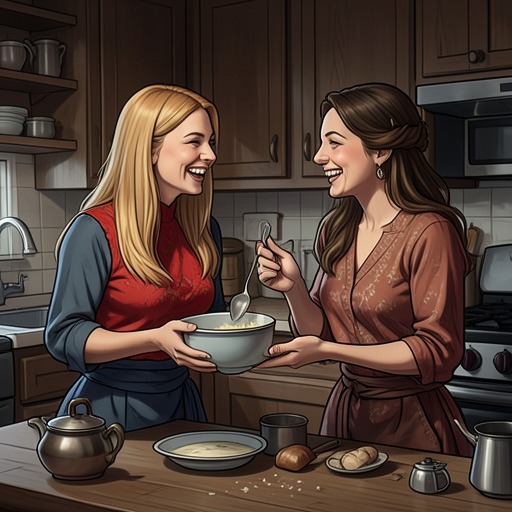
Hideo’s parents’ relationship as a married couple
Strangers (Taichi Yamada Edition)Hideo’s parents’ relationship as a married couple is revealed less through explanations of their past than through the ordinary habits they share when Hideo Harada encounters them in Asakusa. They bicker, joke, work around material limits, and take pleasure in one another’s company; their marriage appears not as an idealized romance but as a lived partnership whose warmth is felt in the rhythm of daily life. That unforced intimacy becomes the emotional center of Hideo’s visits and the reason his final goodbye is so difficult to speak.
A shared home and an informal partnership
The couple’s domestic world is small but cared for. Their worn apartment consists of a kitchenette and a single eight-tatami room, yet Hideo notices that it is clean and tidy. Its modesty is not presented as a crisis between them. His mother says they manage to eat, that an apartment like this is about the best they can hope for, and that she wants to keep living together in their happy-go-lucky way. Her contentment is specifically relational: what matters is not acquiring more but continuing to share this life with her husband.
Their household expresses that partnership through practical hospitality. On one visit, the table is set with edamame and garnished tofu, and three beer glasses are ready. His mother offers Hideo a place between his parents at the low table and pours his beer. When she wishes aloud that they could offer him a shower, his father immediately points out the impossibility of fitting one into their cramped home. The exchange is a small comic disagreement, but it also shows how naturally they negotiate the limits of their shared space: her impulse is to make the guest comfortable, while his joke brings the practical constraint into view without turning it into resentment.
Work, money, and good-humored disagreement
The parents’ marriage includes the instability of the father’s working life. He is a capable sushi chef, praised for precise work, clean habits, and an easy manner with customers, but he has a tendency to leave jobs when he grows tired of a place or takes against something there. His mother explains both his skill and his restlessness, and her account conveys familiarity with a pattern that has recurred over time. When Hideo asks whether his father is working the late shift, his father says he has quit; his mother responds that he has gone and quit again. The repetition is treated as familiar domestic material rather than a rupture in their bond.
The father answers her teasing by insisting that he has never let her go hungry. Beneath the comic defensiveness is a measure of responsibility: his work may be changeable, but he understands provision as part of what he owes his family. His mother’s account of their limited means does not erase that strain, yet neither does it make their marriage seem defined by complaint. The couple’s joking disagreement holds together two views of their life—his confidence that he has provided, and her clear-eyed acceptance of what their resources can afford.
Companionship in shared pleasures
Their closeness is most visible in the way they enjoy time together. At home, they set out beer and snacks, watch the summer high-school baseball tournament, and make room for Hideo at their low table. Later, his father teaches Hideo ways to cheat at Hanafuda cards; the game becomes lively and competitive, with both parents participating rather than merely watching. Hideo is particularly struck by how fluently his mother uses the game’s score terms. Their play gives their marriage a public, animated quality: they answer each other, argue over the game’s rhythm, and seem wholly at ease in their familiar roles.
Food repeatedly carries that companionship into the scene. After the card game, they share an eel dinner. On another visit, Hideo asks his mother to order food in, despite the groceries she has just bought; he understands that the meal is a charade arranged for his benefit. The point is not the food itself but the care enacted through it. His parents make a place for him in a routine that already belongs to them as a couple, and their readiness to do so lets him inhabit the family life he missed.
His father’s reflection over the meal gives that welcome a bittersweet edge. He says that if they had been around, they would not have let Hideo grow into such a know-nothing, while acknowledging that some things cannot be changed. The parents’ banter about what they could have taught a twelve-year-old carries an awareness of lost time; it also shows them speaking together about their absent years as a shared sorrow, softened by familiar teasing rather than solemn declaration.
The final visit and its cost
Hideo recognizes that his parents are enjoying the time with him, and that recognition alters what he can say. As they see him off on International Boulevard, they give him their cheerful invitation to return. He cannot bring himself to tell them that this will be his last visit. Their married ease—visible in the way they banter with each other and welcome him without ceremony—makes a farewell announcement feel like an injury to the very happiness he has come to share.
The final meal takes that domestic bond into a restaurant. Hideo sits opposite his parents, orders the most expensive sukiyaki dinner for three, and says that they can order more meat and vegetables as they go. His father pours him a beer, and the waitress begins preparing the sukiyaki at the table. Even away from their small apartment, the couple’s familiar partnership remains intact: they sit together, include Hideo in their meal, and continue the family conversation around food.
Then his parents vanish, leaving their chopsticks, sukiyaki bowls, half-empty beer glasses, a bag of figurine cakes, a soiled table, and two wrinkled cushions. The meal is still steaming, but the people who made it a family occasion are gone. Hideo’s protest that they have hardly eaten registers the loss through its most ordinary measure: an interrupted dinner. Their relationship matters to the story not because it is explained as a grand romance, but because shared work, jokes, meals, and mutual accommodation have made their togetherness feel continuous—and therefore made its disappearance devastating.